
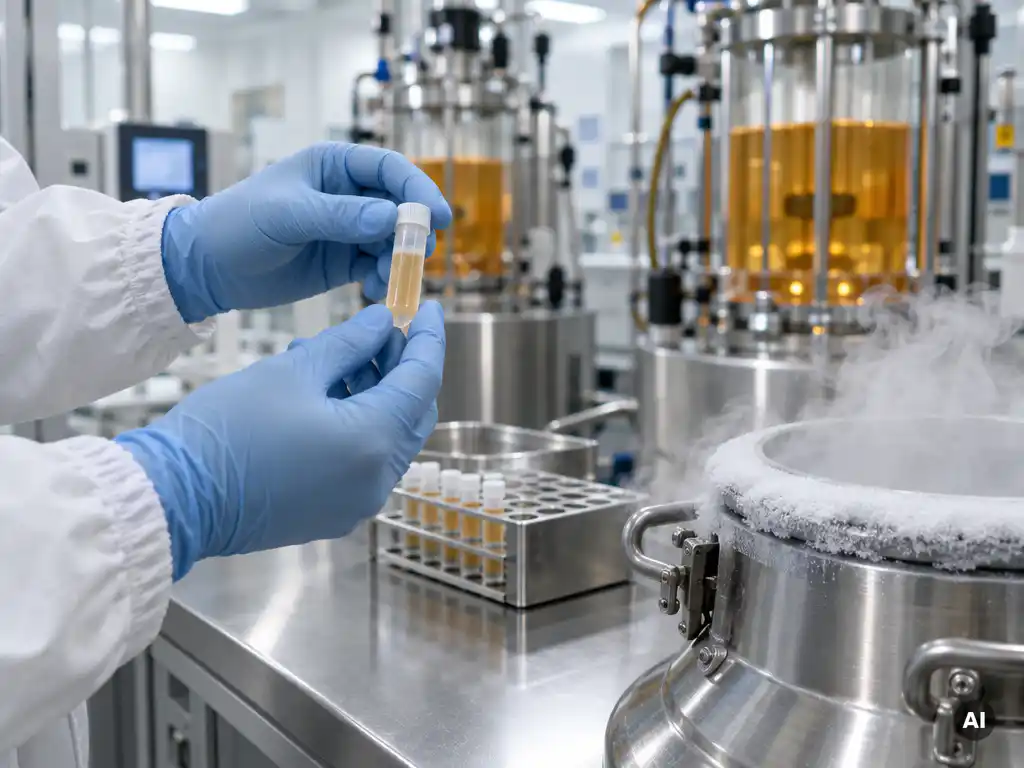
Advanced Therapy Medicinal Products (ATMPs) are medicines for human use based on genes, cells, or tissues. In the European Union, they fall into four categories: gene therapy, somatic cell therapy, tissue-engineered products, and combined ATMPs. They offer new routes to treat or even cure diseases that conventional drugs cannot reach. Below, we answer the most common questions about how ATMPs are defined, regulated, and developed.
What are the four types of ATMPs?
The four types of ATMPs are gene therapy medicinal products, somatic cell therapy medicinal products, tissue-engineered products, and combined ATMPs. Each group is defined by what the product contains and how it works in the body. Together they cover most of today’s cell- and gene-based treatments.
- Gene therapy medicinal products (GTMPs): contain recombinant nucleic acids that regulate, repair, replace, add, or delete a genetic sequence. Examples include viral vector-based therapies and genetically modified cells.
- Somatic cell therapy medicinal products (sCTMPs): contain cells or tissues that have been substantially manipulated, or that are used for a different essential function than in the donor.
- Tissue-engineered products (TEPs): contain engineered cells or tissues intended to regenerate, repair, or replace human tissue.
- Combined ATMPs: combine one of the above with one or more medical devices as an integral part, such as cells seeded onto a biodegradable scaffold.
Understanding which category your product belongs to matters, because it shapes your quality, clinical, and regulatory strategy from day one.
How does the EU classify a product as an ATMP?
The EU classifies a product as an ATMP when it meets the legal definition in Regulation (EC) No 1394/2007 and Directive 2001/83/EC. It must be a gene therapy, somatic cell therapy, or tissue-engineered product, based on its composition and its mode of action. The Committee for Advanced Therapies (CAT) at the EMA provides scientific classification recommendations.
In practice, classification comes down to a few key questions:
- Does the product contain recombinant nucleic acid, or cells and tissues?
- Have the cells been substantially manipulated, or are they used for a non-homologous function?
- Is the product presented as having properties for treating, preventing, or diagnosing disease, or for regenerating, repairing, or replacing tissue?
Borderline cases are common, especially with novel technologies. Developers can request a classification opinion from the CAT early on. This is a smart move, since a wrong assumption about classification can delay your ATMP development by months.
How are ATMPs regulated in the European Union?
ATMPs are regulated in the EU under Regulation (EC) No 1394/2007, which sits on top of the general pharmaceutical legislation. Marketing authorization runs through the centralized procedure, so the EMA evaluates the product and the European Commission grants a single authorization valid across all member states. The CAT prepares the draft opinion for the CHMP.
Several elements make the ATMP framework distinctive:
- The centralized procedure is mandatory: national routes are not an option for a marketing authorization.
- GMP for ATMPs: specific EU GMP guidelines for ATMPs address aseptic processing, traceability, and short shelf lives.
- Clinical trials: ATMP clinical trials fall under the EU Clinical Trials Regulation, with extra attention to long-term follow-up, biodistribution, and safety monitoring.
- Risk-based approach: developers can justify the extent of quality, nonclinical, and clinical data based on a product-specific risk analysis.
Quality is often the hardest part. Topics such as ATMP starting materials, ATMP potency assays, ATMP comparability after process changes, and ATMP manufacturing scale-up come up repeatedly in agency interactions. Strong CMC planning early on pays off later. Our CMC support covers many of these topics.
How do combined ATMPs interact with medical device rules?
A combined ATMP must contain a medical device as an integral part of the product, so both medicinal product and device requirements apply. The ATMP rules govern the overall authorization, while the device component must meet the relevant essential requirements under the EU Medical Device Regulation (MDR) 2017/745.
For a combined ATMP, the device part may be a scaffold, matrix, or delivery system. The cellular or gene-based part must be viable or have a primary action that is not achieved by the device. If the device is not integral, the product may instead be a standard ATMP used together with a separate device, which changes the regulatory route.
Practical points to keep in mind:
- The EMA assesses the device part as part of the ATMP dossier, and a notified body opinion on conformity may be needed if the device is not already CE marked.
- Documentation must show how the device and the cell or gene component interact, including compatibility and performance.
- Responsibilities between the ATMP and device manufacturers should be clearly defined, especially when different parties are involved.
Combined ATMPs sit in a complex space, so bringing in both medicinal product and device expertise early avoids surprises.
What is the hospital exemption for ATMPs?
The hospital exemption allows an ATMP to be prepared on a non-routine basis and used within the same member state, in a hospital, under the exclusive professional responsibility of a medical practitioner, for an individual patient and in accordance with a custom-made prescription. It is an exception to the centralized marketing authorization requirement and is intended for specific, limited situations.
Key features of the hospital exemption include:
- It applies to products prepared on a non-routine basis, not to industrial-scale manufacturing.
- Use must take place in a hospital in the same member state where the product was made.
- The national competent authority must authorize the manufacture, and quality standards equivalent to those at the EU level must be met.
- Traceability and pharmacovigilance requirements still apply.
Each member state implements the exemption differently, which creates a patchwork of rules. For developers, the hospital exemption is not a substitute for a full development plan, but it can matter for academic groups and small centers working on personalized treatments. Understanding how it interacts with the centralized route is useful when planning a long-term strategy.
What are the biggest regulatory challenges for ATMP developers?
The biggest regulatory challenges for ATMP developers are manufacturing consistency, product characterization, small and variable patient populations, and navigating evolving EU requirements. Because many ATMPs are living, patient-specific products, standard approaches from small molecules and conventional biologics rarely apply without adaptation.
Manufacturing and quality control
Cell therapy manufacturing is complex. Autologous vs allogeneic cell therapy models each bring their own issues: autologous products depend on variable patient material and tight logistics, while allogeneic products need robust donor screening and scalable processes. Reliable ATMP quality control, including validated potency assays and well-defined starting materials, is essential. Process changes during development also trigger comparability exercises that can be demanding for products with limited batch sizes.
Clinical development and personalized approaches
ATMP clinical trials often involve small populations, single-arm designs, and long-term follow-up. Many ATMPs are tied to personalized medicine and precision medicine concepts, which means patient stratification, biomarkers, and sometimes companion diagnostics play a central role. Biomarker-driven clinical trials and genomic biomarkers can help select patients who are most likely to respond, but they add regulatory layers, since a companion diagnostic must also meet its own requirements. Early scientific advice from the EMA can help align on trial design and endpoints.
Other recurring hurdles include keeping pace with changing guidance, managing cross-border logistics, and coordinating between medicinal product and device rules for combined ATMPs. A clear regulatory roadmap, built early and updated as the product matures, reduces risk considerably.
How Starodub helps with ATMP development
Bringing an ATMP to market takes more than good science. It takes a regulatory and quality strategy that holds up at every stage. We support biopharmaceutical and medical device companies with the full range of regulatory needs, from early classification questions to marketing authorization. Our team brings hands-on experience from over 400 completed projects for more than 300 clients, including complex biological products and combination products.
Here is how we can help:
- Classification and pathway strategy: we help you determine whether your product is an ATMP, a combined ATMP, or a medical device, and map the right regulatory route.
- CMC and quality: we support dossier preparation, starting materials, potency assays, comparability, and scale-up planning through our CMC services.
- Regulatory submissions: we prepare and manage clinical trial applications, scientific advice requests, and marketing authorization applications.
- Combined ATMP and device guidance: we bridge medicinal product and medical device requirements, including MDR interplay.
- Quality and compliance: our Quality, Compliance and Operational Improvements division, led by Lean Six Sigma Master Black Belts, helps you strengthen GMP readiness and streamline operations.
We work with short reporting lines and a single point of contact, backed by the expertise of our whole team. Ready to move your ATMP forward? Get in touch with us and let us build your regulatory strategy together.
Related Articles
- How do you build a regulatory intelligence program from scratch?
- How does Phase I to Phase III strategy differ?
- What is a drug development strategy?
- How do you prepare a regulatory submission for the EMA?
- Who needs to submit an IND application?
This content was generated with the help of AI and it may contain mistakes
