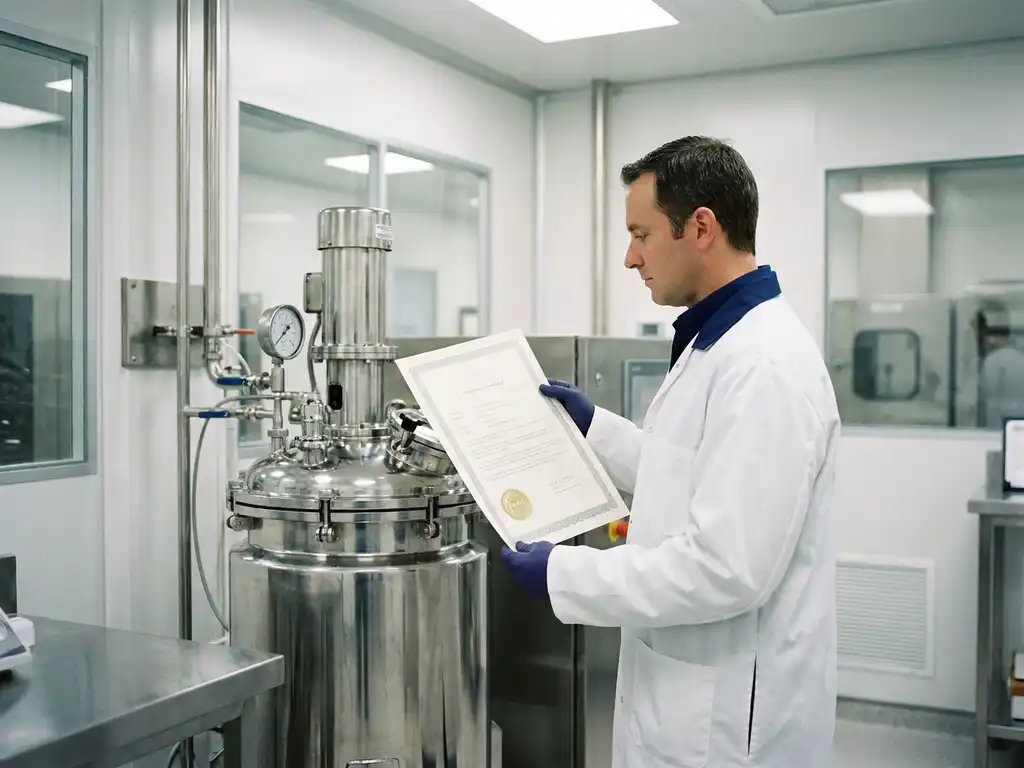
GMP compliance and GMP certification are related but distinct concepts. GMP compliance means that a manufacturing site operates in accordance with Good Manufacturing Practice regulations, while a GMP certificate is an official document issued by a regulatory authority confirming that a site has been inspected and found to meet those standards. Compliance is the ongoing state; certification is the formal, documented proof of it. The sections below unpack the practical differences, explain when each matters, and clarify what happens when either is called into question.
Does GMP compliance require a certificate?
GMP compliance does not automatically require a certificate. A manufacturing site can be fully compliant with GMP regulations without holding a formal GMP certificate. Compliance is a continuous operational standard, meaning a site must follow GMP requirements at all times regardless of whether it has been formally certified by an authority.
That said, a GMP certificate is often a practical necessity rather than a strict legal one. For example, when a pharmaceutical manufacturer supplies active pharmaceutical ingredients (APIs) or finished products to regulated markets such as the EU, trading partners and competent authorities frequently request a certificate as documented evidence of compliance. The certificate does not create compliance; it confirms it.
In short, the obligation is to be compliant. The certificate is evidence that an independent authority has verified that obligation is being met.
How is GMP compliance assessed and by whom?
GMP compliance is assessed through inspections conducted by regulatory authorities or, in some cases, by qualified third-party auditors. In the EU, national competent authorities such as the Medicines Evaluation Board (CBG-MEB) in the Netherlands or the MHRA in the UK carry out GMP inspections. The EMA coordinates inspections for centrally authorised products.
During an inspection, assessors evaluate a wide range of operational areas, including:
- Quality management systems and documentation practices
- Personnel qualifications and training records
- Premises, equipment, and environmental controls
- Production processes and in-process controls
- Laboratory controls and testing procedures
- Batch release processes and deviation management
Inspections can be routine, triggered by a specific application such as a marketing authorisation, or follow-up inspections responding to a reported issue. The frequency depends on the risk profile of the site and the type of products manufactured. Third-party audits by contract organisations or partner companies serve a similar evaluative function but do not carry the same regulatory weight as an official inspection.
What is a GMP certificate and how is it issued?
A GMP certificate is an official document issued by a national competent authority confirming that a manufacturing site has been inspected and found to comply with GMP requirements. In the EU, this takes the form of a Manufacturing Authorisation or a GMP Certificate of Compliance issued following a satisfactory inspection outcome.
The process generally works as follows:
- A regulatory authority schedules or announces an inspection of the manufacturing site.
- Inspectors assess the site against the relevant GMP guidelines, such as EU GMP Annex guidelines or ICH Q7 for APIs.
- If the site meets the required standards, the authority issues a certificate, typically valid for a defined period, often two to three years.
- The certificate is entered into public databases such as the EudraGMDP database, which is accessible to authorities and industry worldwide.
For sites outside the EU supplying medicinal products into the European market, GMP certificates may be issued under mutual recognition agreements (MRAs) between the EU and third countries, or following a dedicated inspection by an EU authority.
When do you need a GMP certificate versus proof of compliance?
Whether you need a formal GMP certificate or another form of compliance evidence depends on the regulatory context, the type of product, and the market you are supplying. A GMP certificate is typically required when a regulatory authority or a marketing authorisation holder needs documented, independently verified confirmation of a site’s status. To learn more about how we approach these regulatory challenges, visit our company page.
Common situations where a GMP certificate is specifically required include:
- Submitting a marketing authorisation application in the EU that references a manufacturing site
- Importing medicinal products into the EU from a third country
- Responding to regulatory requests during product approval or post-approval variations
- Satisfying due diligence requirements from business partners or licensing counterparts
Proof of compliance in a broader sense, such as internal audit reports, quality agreements, or self-inspection records, may be sufficient for internal purposes or for lower-risk supply chain decisions. However, for regulatory submissions and cross-border trade in medicinal products, a certificate from a recognised authority carries significantly more weight than self-declared compliance documentation.
Can a site be GMP compliant but not GMP certified?
Yes, a site can be GMP compliant without holding a current GMP certificate. This situation arises more often than many assume. A newly established manufacturing facility, for example, may have implemented all required GMP systems and procedures but not yet undergone its first regulatory inspection. The site is operating compliantly but has not yet received formal certification.
Similarly, sites that manufacture products not yet subject to a marketing authorisation, or that supply markets where certification is not a regulatory prerequisite, may maintain robust GMP compliance without a certificate on file. Compliance is the operational reality; certification is the formal recognition of that reality by an external authority.
It is worth noting that operating without a certificate in markets where one is required would constitute a regulatory violation, even if the site is genuinely compliant. The certificate is not merely a formality in those contexts; it is a legal prerequisite for market access.
What happens when GMP certification lapses or compliance fails?
When a GMP certificate lapses or compliance failures are identified, the consequences can be significant and can affect both the site and the products it manufactures. Regulatory authorities take a risk-based approach to enforcement, but the potential outcomes range from formal warnings to full suspension of manufacturing activities.
When a certificate lapses
A GMP certificate has a defined validity period. If a site does not undergo a renewal inspection in time, the certificate expires. In the EU, an expired certificate means the site’s status in the EudraGMDP database is no longer current, which can block batch releases, trigger questions from marketing authorisation holders, and create complications for import and export. Proactive scheduling of renewal inspections is essential to avoid gaps in certification status.
When compliance failures are identified
If an inspection identifies significant GMP deficiencies, the authority may issue a non-compliance statement or a critical observation requiring immediate corrective action. In serious cases, a site may receive a suspension of its manufacturing authorisation, meaning it cannot legally produce or release products until the issues are resolved. Products already on the market may be subject to recall if they were manufactured under conditions that did not meet GMP standards.
Compliance failures also carry reputational consequences. Inspection outcomes are often publicly accessible, and business partners, licensing counterparts, and competent authorities in other markets monitor this information closely. Recovering from a serious GMP finding requires not only corrective actions but also a demonstrated commitment to sustainable quality system improvements. Our full range of services is designed to support companies at exactly these critical moments.
How Starodub supports your GMP compliance and certification journey
Navigating the line between maintaining GMP compliance and securing or renewing formal GMP certification requires both regulatory expertise and practical operational knowledge. We at Starodub provide hands-on support to biopharmaceutical and medical device companies at every stage of this process. Our services in this area include:
- GMP gap assessments to identify where your current systems stand relative to EU GMP requirements and what needs to be addressed before an inspection
- Inspection readiness preparation, including mock inspections, documentation reviews, and coaching for site personnel
- CAPA support following inspection findings, helping you develop credible corrective and preventive action plans that satisfy regulatory expectations
- Regulatory strategy advice on manufacturing authorisation applications and the management of site-related variations in marketing authorisations
- Quality system improvements through our Quality, Compliance and Operational Improvements division, led by Lean Six Sigma Master Black Belts with over 25 years of pharmaceutical industry experience
Whether you are preparing for your first GMP inspection, managing a certification renewal, or responding to a compliance finding, we bring the regulatory depth and practical experience to help you move forward with confidence. Get in touch with us to discuss your specific situation and find out how we can support your path to and through GMP certification.
Related Articles
- How does Phase I to Phase III strategy differ?
- How do post-approval changes affect existing regulatory submissions?
- What is GMP compliance and why does it matter?
- What regulatory strategy considerations apply to biosimilars?
- Is the EMA more strict than the FDA?
This content was generated with the help of AI and it may contain mistakes