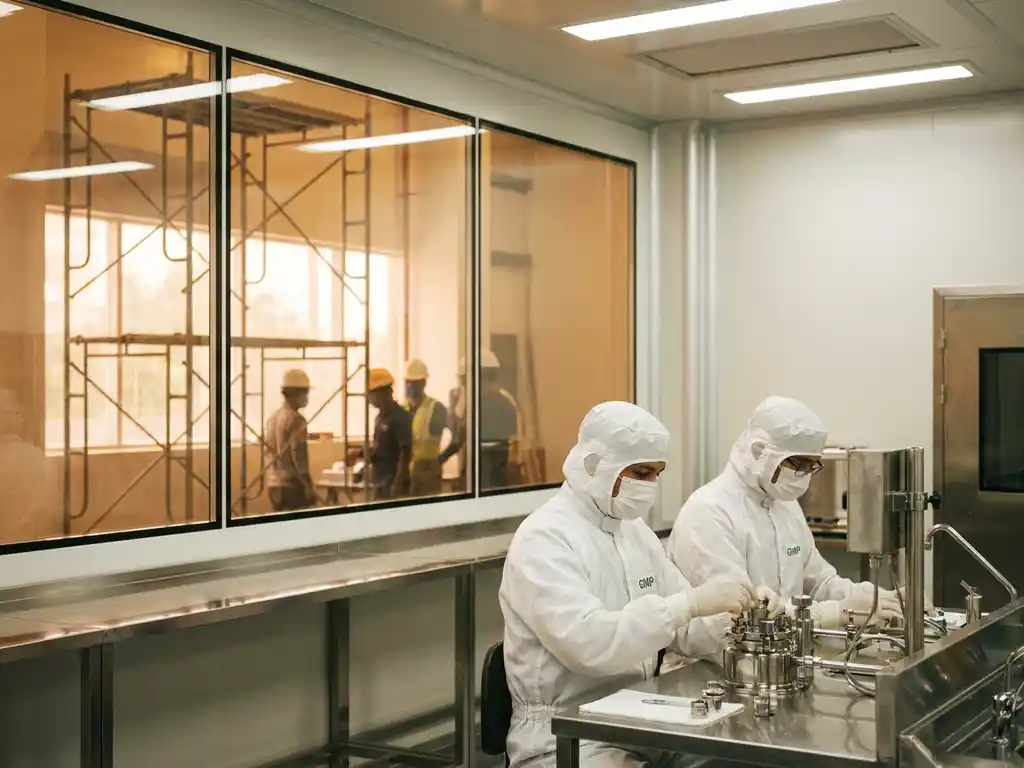
Maintaining GMP compliance during a facility expansion requires proactive change control, thorough qualification of new spaces and equipment, and timely regulatory notification before any expanded operations begin. The core challenge is that construction and commissioning activities create disruption that can compromise existing manufacturing processes if not carefully managed. The sections below address the most common questions companies face when planning or executing a GMP-compliant expansion.
What are the biggest GMP risks when expanding a facility?
The biggest GMP risks during a facility expansion are cross-contamination between construction zones and active manufacturing areas, disruption to environmental monitoring systems, lapses in personnel access controls, and documentation gaps that leave change history incomplete. Each of these can directly compromise product quality or trigger regulatory findings during an inspection.
Construction activities introduce particulates, microbial load, and chemical residues that can migrate into cleanrooms or production corridors. Physical barriers, pressure differentials, and dedicated gowning procedures for contractors must be established before any work begins. Environmental monitoring frequency should increase during the expansion period, not decrease, because baseline conditions are temporarily altered.
Personnel and access control is another underestimated risk. Contractors unfamiliar with GMP culture may inadvertently enter restricted zones, touch equipment, or bypass hygiene procedures. A clear site access plan, mandatory GMP awareness training for all contractors, and a visitor log that distinguishes between construction staff and qualified personnel are minimum safeguards.
Documentation risk is equally serious. Any change made during an expansion that is not captured in the change control system creates a gap in the site’s compliance history. This includes seemingly minor decisions such as relocating a utility connection or substituting a building material. Everything that affects the validated state of the facility must be recorded.
What change control steps apply to a facility expansion?
A facility expansion must be initiated through the site’s formal change control procedure, which typically includes a change request, a risk assessment, an impact assessment covering validated systems and regulatory filings, an implementation plan, and a closure review with supporting qualification data. No construction that affects GMP-relevant areas should begin without an approved change control record.
The impact assessment is the most critical step. It must evaluate whether the expansion affects any validated processes, utilities, HVAC zones, or equipment qualifications. It should also identify which regulatory submissions, such as manufacturing authorizations or marketing authorization dossiers, will require updates as a result of the change.
Once the scope is approved, implementation should follow a staged approach:
- Segregate construction zones from active GMP areas with physical barriers and negative pressure where needed
- Maintain a construction log that links each activity to the corresponding change control record
- Conduct interim inspections at defined milestones before closing walls or installing finishes
- Complete commissioning and qualification before any new area is used for GMP activities
- Perform a formal change control closure review with sign-off from Quality, Engineering, and Regulatory
Change control closure should not happen until all qualification protocols have been executed, deviations resolved, and updated SOPs are in place and staff are trained.
When do you need to notify regulators about a facility expansion?
You need to notify regulators about a facility expansion when it constitutes a change to the manufacturing authorization or when it affects information already submitted in a marketing authorization dossier. In the EU, changes to a manufacturing site’s approved scope or layout typically require a variation to the manufacturing authorization issued by the national competent authority, and depending on the product, a corresponding variation to the marketing authorization.
The classification of the regulatory notification depends on the nature and scale of the change. Adding a new manufacturing suite, expanding into a new building, or introducing a new dosage form capability generally requires prior approval before operations begin. Modifications that do not change the approved scope, such as refurbishing an existing room with equivalent materials, may qualify as a notification or annual report update.
For products with EU marketing authorizations, any change affecting Module 3 information, such as manufacturing site details or process descriptions, must be filed as a Type IA, Type IB, or Type II variation depending on the risk classification. Companies should assess this in parallel with the internal change control process, not after construction is complete, to avoid operating in a state that is not reflected in the approved dossier. Our regulatory services cover the full range of variation types and can help you determine the correct classification from the outset.
Early engagement with regulatory affairs before breaking ground prevents the costly situation of completing an expansion that cannot be used because the regulatory filing has not yet been approved.
How do you qualify new areas and equipment during an expansion?
New areas and equipment must be qualified through a structured sequence of Installation Qualification (IQ), Operational Qualification (OQ), and Performance Qualification (PQ) before any GMP use. For facilities, this also includes commissioning of utilities such as HVAC, purified water, and compressed gases, which must demonstrate consistent performance under realistic operating conditions.
Qualification should be driven by a master qualification plan that defines the scope, responsibilities, acceptance criteria, and linkage between individual qualification protocols. Each protocol should reference the approved change control record and the user requirement specification that defines what the area or equipment must achieve.
For cleanrooms and controlled environments, qualification includes room classification studies (particle counts), pressure differential mapping, air change rate verification, and temperature and humidity profiling. These studies must be repeated after any significant modification to the HVAC system and should be conducted with the room in its operational configuration, not empty.
Equipment installed in new areas carries its own qualification requirements. Even if a piece of equipment has been qualified elsewhere on site, relocation to a new environment requires, at minimum, requalification of installation and operational parameters, because utility connections, environmental conditions, and spatial relationships may differ.
How should you handle GMP inspections during an active expansion?
During an active facility expansion, you should be fully transparent with inspectors about the scope and status of construction, provide a clear site map distinguishing active GMP areas from construction zones, and demonstrate that robust controls are in place to prevent the expansion from affecting product quality. Inspectors do not expect perfection during construction, but they do expect control.
Prepare an inspection readiness package specific to the expansion that includes the approved change control records, the qualification plan, the construction timeline, and the risk assessment showing how GMP operations are protected. Being able to walk an inspector through the change control history from initiation to current status demonstrates that the site is managing the change systematically.
If an inspection occurs while construction is ongoing, restrict inspector access to the construction zone unless they specifically request it, and ensure a qualified site representative accompanies any tour of the area. Never allow inspectors to enter active construction zones without appropriate safety and hygiene controls in place.
Observations related to ongoing construction are less likely to become critical findings when the site can show that every risk has been identified, assessed, and mitigated through documented controls. The worst outcome in an inspection is an inspector discovering a change that is not reflected in the change control system.
What’s the difference between a site extension and a new manufacturing site?
A site extension is an expansion of the physical footprint of an existing, authorized manufacturing site, typically on the same premises or an adjacent plot, that remains under the same manufacturing authorization. A new manufacturing site is a separate, independently authorized facility that requires its own manufacturing license and, where applicable, its own regulatory submissions for each product manufactured there.
The distinction matters significantly for regulatory strategy. A site extension generally involves a variation to the existing manufacturing authorization and, depending on the products involved, corresponding variations to marketing authorization dossiers. The regulatory pathway is faster because the site already has an established compliance history and an existing relationship with the competent authority.
A new manufacturing site, by contrast, requires the competent authority to grant a new manufacturing authorization following a pre-approval inspection. For products already on the market, transferring manufacturing to a new site requires a Type II variation or equivalent, which involves a full technical dossier update and can take twelve months or longer to approve in some jurisdictions.
From a practical standpoint, companies should evaluate early in the planning process whether the expansion can be structured as a site extension rather than a new site, because the regulatory timeline and resource requirements differ substantially. This decision is best made with regulatory input before architectural plans are finalized. To learn more about our background and approach to these strategic assessments, visit our company page.
How Starodub supports GMP compliance during facility expansions
We work with biopharmaceutical and medical device companies at every stage of a facility expansion, from the initial regulatory impact assessment through to post-expansion inspection readiness. Our team brings hands-on experience with EU manufacturing authorization variations, GMP change control frameworks, and qualification strategies for complex facility projects.
Specifically, we help clients with:
- Assessing whether a planned expansion triggers regulatory notifications or variations, and classifying those changes correctly under EU and ICH frameworks
- Drafting and submitting manufacturing authorization variations to national competent authorities
- Preparing the regulatory sections of marketing authorization variations linked to facility changes
- Reviewing change control documentation and qualification plans to ensure they meet GMP expectations
- Supporting inspection preparation, including mock inspections and gap assessments specific to the expansion scope
- Advising on the strategic choice between structuring a project as a site extension versus a new manufacturing site
Whether you are planning an expansion in 2026 or managing one already in progress, early regulatory input prevents delays and reduces the risk of non-compliance. Contact Starodub to discuss how we can support your facility expansion with practical, expert regulatory guidance from day one.
Related Articles
- What is the difference between an MAA and a BLA submission?
- Why is regulatory affairs strategy important for pharmaceutical companies?
- Drug-Device Combination Products: Regulatory Framework Explained
- What are the key differences between IVDR and MDR regulations?
- How do you maintain regulatory compliance after approval?
This content was generated with the help of AI and it may contain mistakes