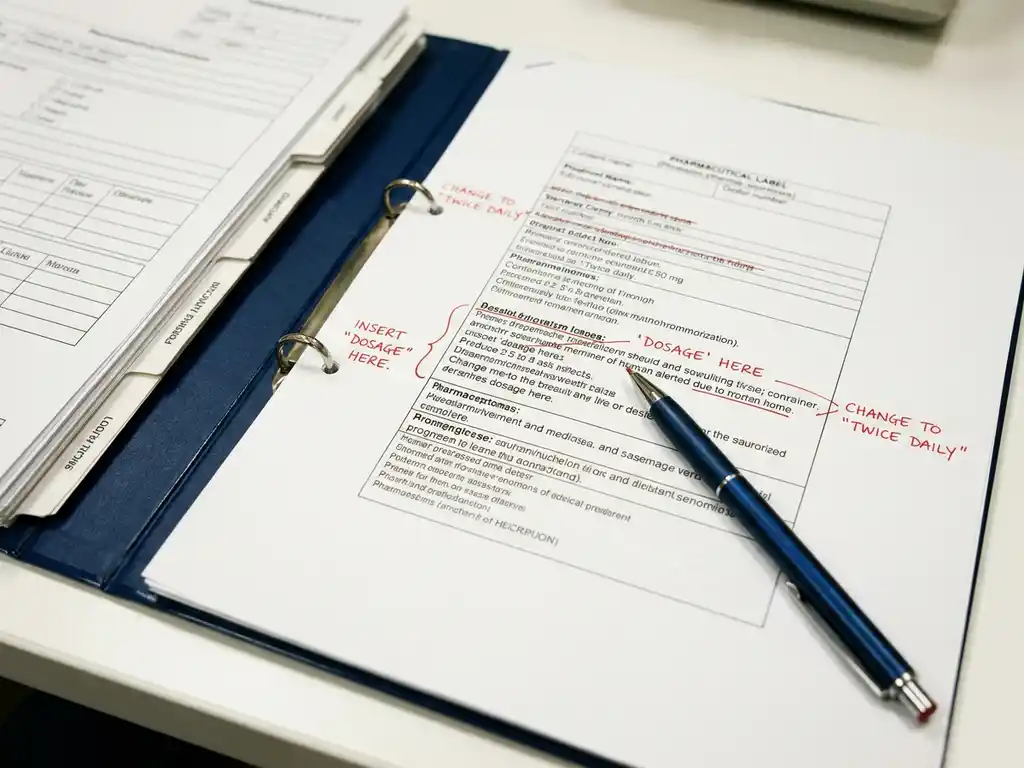
Managing labelling changes in a regulatory submission means identifying whether your change requires a formal variation, notifying the relevant authority, or can be handled through a self-declaration, and then preparing the correct documentation to support that change. The classification of the change determines the procedural route, the timeline, and the level of scrutiny involved. The sections below walk through the most important questions companies face when handling labelling updates.
What types of labelling changes require a regulatory submission?
Not every labelling update automatically triggers a formal regulatory submission, but many do. Changes that affect the approved product information, such as updates to the summary of product characteristics (SmPC), package leaflet, or outer and immediate labelling, generally require a variation submission. The specific type of variation depends on the nature and risk level of the change.
Common labelling changes that require a regulatory submission include:
- Updates to indication, dosage, or route of administration
- New or revised warnings, contraindications, or precautions
- Changes to the product name or marketing authorisation holder details
- Reformulation of excipients that affects labelling content
- Addition of new storage conditions or shelf-life information
- Corrections to factual errors in approved product information
Minor administrative updates, such as correcting a typographical error that does not affect the content of the approved product information, may qualify for a lower-level procedure or even a notification, but you should always verify this against current EU guidelines before proceeding.
How do you classify a labelling change under EU regulations?
Under EU regulations, a labelling change is classified as either a Type IA, Type IB, or Type II variation, depending on its potential impact on quality, safety, or efficacy. Type IA covers minor changes with minimal risk, Type IB covers moderate changes, and Type II applies to major changes that may significantly affect the benefit-risk profile of the product.
The EU Variation Regulation (EC) No 1234/2008 and its associated guidelines provide a classification list that maps specific labelling changes to their variation category. When a change does not appear on this list, you apply the default classification criteria, weighing the potential impact on the product’s benefit-risk balance.
For centrally authorised products, submissions go to the European Medicines Agency (EMA). For nationally authorised products, they go to the relevant national competent authority, or through the mutual recognition or decentralised procedure if multiple member states are involved. Correctly classifying the change from the outset avoids procedural delays and prevents the authority from reclassifying your submission to a higher variation type. If you are unsure which route applies to your product, reviewing the full range of regulatory services available can help you identify the right approach from the start.
What documentation is needed to support a labelling change submission?
A labelling change submission requires a completed application form, the revised labelling texts in the appropriate format, a clear comparison between the current and proposed versions, and a justification explaining why the change is necessary and how it has been classified. The exact documentation set depends on the variation type.
For most labelling variations, you will need:
- The revised SmPC, package leaflet, and labelling in the required language versions
- A tracked-changes version showing exactly what has been modified
- A cover letter explaining the rationale and regulatory basis for the change
- Supporting data or references if the change is driven by new clinical, safety, or quality information
- For Type II variations, a full benefit-risk assessment may be required
All documents must be submitted in the correct eCTD format where applicable. Incomplete or poorly formatted submissions are one of the leading causes of clock-stops and delays.
How long does a labelling change submission take to get approved?
The approval timeline for a labelling change submission depends on the variation type. Type IA variations are implemented immediately upon submission and confirmed within 12 months. Type IB variations have a 30-day review period, after which the change is approved unless the authority raises objections. Type II variations follow a 60-day procedure, which can extend to 90 days or longer if the authority requests additional information.
In practice, timelines can stretch beyond these standard windows. Clock-stops occur when authorities issue questions or requests for supplementary data, pausing the review clock until you respond. For complex labelling changes tied to new safety data or significant clinical updates, the review can take several months. Planning your submission timeline with these potential extensions in mind is essential, particularly when labelling updates are tied to product launches or post-approval commitments.
What are the most common mistakes in labelling change submissions?
The most common mistakes in labelling change submissions are misclassifying the variation type, submitting incomplete documentation, and failing to align the revised labelling text across all related documents. These errors lead to clock-stops, requests for additional information, or outright refusals that delay the approval process significantly.
Other frequent issues include:
- Inconsistent text across documents: The SmPC, package leaflet, and outer labelling must be fully aligned. Discrepancies between them are a common trigger for authority questions.
- Incorrect eCTD formatting: Submissions that do not meet technical formatting requirements are often rejected at validation before they even reach scientific review.
- Insufficient justification: A cover letter that simply states what changed without explaining why, or without citing the relevant regulatory basis, weakens the submission.
- Missing language versions: For products authorised in multiple member states, failing to include all required language translations is a straightforward but avoidable error.
- Underestimating the variation type: Submitting a change as Type IA when it should be Type IB or Type II is one of the most consequential mistakes, as authorities will reclassify the submission and restart the clock.
When should you group labelling changes into a single submission?
You should group labelling changes into a single submission when the changes are related, when combining them reduces the administrative burden without creating regulatory complexity, and when all changes fall within the same or compatible variation categories. Grouping unrelated or differently classified changes can complicate the review and may not be permitted under current guidelines.
EU variation guidelines allow for worksharing and grouped submissions under specific conditions. If multiple changes to the same product all qualify as Type IA, they can typically be submitted together. Mixing Type IA and Type IB changes in one submission is generally handled under the higher category. Grouping a Type II change with lower-level changes is more complex and requires careful assessment of whether the authority will accept the combined submission.
Practically, grouping makes sense when you are updating labelling following a periodic safety update report (PSUR) outcome, implementing multiple post-approval commitments simultaneously, or rolling out a coordinated label refresh. Grouping reduces submission fees, simplifies project management, and avoids multiple overlapping review timelines for the same product. To understand how an experienced regulatory partner can support this process, visit our company page to learn more about our background and approach.
How Starodub helps with labelling change submissions
Labelling changes sit at the intersection of regulatory strategy, scientific accuracy, and procedural compliance. Getting the classification wrong, submitting incomplete documentation, or misjudging the right moment to group changes can cost months of delay. We support companies through every stage of the process, from initial assessment to approved implementation.
When you work with us on labelling change submissions, we provide:
- Variation classification assessments to determine the correct procedural route under EU regulations
- Preparation and review of all submission documents, including revised SmPC, package leaflet, and labelling texts
- Tracked-changes documents and cover letters with clear regulatory justifications
- eCTD formatting and technical submission support for EMA and national competent authority submissions
- Strategic advice on whether to group changes and how to sequence submissions efficiently
- Ongoing communication management with authorities during the review period
With over 400 completed projects and a team of regulatory experts across medicinal products and medical devices, we bring the experience needed to keep your labelling submissions on track. If you have a labelling change coming up and want to make sure it is handled correctly from the start, contact Starodub today to discuss your situation with one of our specialists.
Related Articles
- What makes a drug development strategy fail in early clinical stages?
- What is the difference between GMP and cGMP compliance?
- What are the market access requirements in China for medical devices?
- ISO 13485 Certification: Requirements, Process and Common Pitfalls
- What is medical device regulation?
This content was generated with the help of AI and it may contain mistakes